
GeoPark's proposed entry into Venezuela's Bare Block is more than a significant oil and gas transaction. It is an unusually clear illustration of how market access, local relationships, operating capability, capital, contractual protection and corporate control can converge in a single emerging-markets deal.
The transaction gives GeoPark exposure to the Bare Block, a producing heavy-oil asset in the Orinoco Heavy Oil Belt, through a 25-year Production Participation Contract with PDVSA Petroleo S.A. GeoPark says the asset has approximately 15.7 billion barrels of original oil in place, about 1,100 existing wells and current gross production of approximately 11,000 barrels per day. Baker McKenzie describes the overall transaction as valued at approximately US$1.2 billion.
The detail matters because this is not simply an acquisition of an oil asset. It combines market entry, a state-facing operating contract, an acquisition, a major equity issuance, a change of corporate control and substantial future development capital.
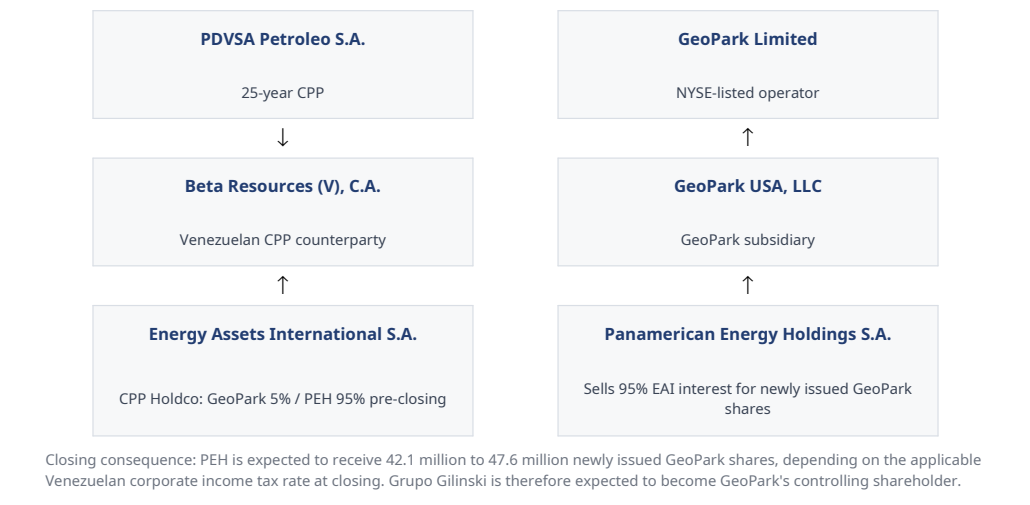
How the transaction fits together
The public filings show a multi-layered structure in which the project interest, corporate acquisition and future control of GeoPark are connected. The CPP itself does not appear in the SEC exhibits reviewed for this briefing.
1.Market access is itself a valuable contribution
GeoPark states that the Bare opportunity was led by Grupo Gilinski and that its strategic presence in Venezuela was instrumental in securing the 25-year CPP framework. GeoPark initially holds 5% of the project holding company and has agreed to acquire Grupo Gilinski's remaining 95%.
That is important well beyond Venezuela. In many emerging-market transactions, the international investor contributes capital, technology and operating expertise while the local or regional party contributes access, relationships, a license, a concession, land, an operating platform or the regulatory route that makes the transaction possible.
The right question is not merely how much cash each party is investing. It is what each party is actually bringing to the transaction, how difficult it would be to recreate, and how that value should be reflected in economics, governance and control.
The GeoPark structure provides an unusually visible example. The market-access contribution is not simply being monetized through a fee or a passive minority participation. It is being converted into a substantial equity position in the international operator itself.
2.The project transaction and the corporate transaction need to be negotiated together
The SEC filing states that PEH will receive between approximately 42.1 million and 47.6 million newly issued GeoPark shares for its 95% interest in Energy Assets International, depending on the applicable Venezuelan corporate income tax rate at closing. GeoPark's September 2 announcement describes the base issuance at US$12.22 per share and says Grupo Gilinski is expected to hold approximately 56.3% of GeoPark after the base issuance, potentially increasing to approximately 58.4%.
The broader lesson is that a transaction that starts as access to an asset, concession or strategic partnership can ultimately determine who controls the company, who funds expansion, who appoints management, who can block major decisions and who captures the upside on exit.
For owners and entrepreneurs, the percentage ownership negotiated on day one is only one part of the bargain. Parties also need to model future capital calls, new debt, equity issuance, expansion, refinancing and exit before they agree the headline economics.
3.In politically complex markets, contractual protection is part of the economics
Under the CPP framework described by GeoPark, the operator will fund 100% of capital expenditures under approved work programs and hold a 65% net working interest. GeoPark says the contractual framework includes direct commercialization and monetization rights, access to critical infrastructure, operational-control provisions, economic-rebalancing mechanisms and compensation protections designed to mitigate operational disruption.
Those protections are not legal appendices to the commercial bargain. Where project economics depend heavily on government action, regulated infrastructure, export permissions, tax treatment, currency availability, licenses or a state-owned counterparty, the allocation of regulatory and political risk is part of the underlying economics.
A nominal percentage is only meaningful once the investor understands what can change the value represented by that percentage and who bears the consequences when it does.
4.Sanctions and dispute resolution can shape the transaction itself
The transaction is occurring during a period of substantial change in Venezuela's hydrocarbons framework and U.S. sanctions policy. GeoPark says the CPP effective date remains subject to applicable approvals, authorizations, regulatory requirements and sanctions-related compliance requirements.
OFAC amended a series of Venezuela-related general licenses on August 27, 2026. OFAC FAQ 1267 confirms that certain licenses no longer require covered contracts with the Government of Venezuela or specified blocked persons to use U.S. governing law. FAQ 1268 nevertheless requires dispute-resolution proceedings under relevant covered contracts to occur in the United States, United Kingdom, France or Singapore.
The public materials do not establish which particular general license or authorization applies to every element of the GeoPark structure. The broader lesson is that sanctions analysis cannot sensibly be left until after the commercial structure is agreed. It may affect counterparties, payments, closing conditions, governing law and enforceability.
5.Preserve capital for the business that must be built after closing
GeoPark says the transaction is financed with equity to preserve financial strength and cash position. It reports access to approximately US$700 million of liquidity and committed or negotiated financing sources, including approximately US$310 million of cash, while contemplating significant redevelopment of the Bare Block alongside its other Latin American operations.
Winning an acquisition, concession or strategic partnership is only the beginning. The investor may then need capital for rehabilitation, drilling, EPC works, infrastructure, working capital, guarantees and contingencies. The useful financing question is therefore not simply how to fund the acquisition, but how to finance the whole business plan while preserving resilience if implementation takes longer or costs more than expected.
The wider transaction lesson
What makes the GeoPark transaction particularly instructive is that the usual distinction between “international investor” and “local partner” does not adequately describe it. A regional investor helped create and secure the opportunity. An established international operator contributes technical and operating capability. A state-owned entity remains central to the project framework. The operating contract allocates commercial, regulatory and political risks. And the consideration for the project interest changes control of the international operator itself.
That is often the reality of major emerging-market transactions: different forms of value and leverage are interacting at the same time.
For international companies entering a new market, the lesson is to recognize the value and negotiating position of the local or regional partner while structuring governance, economics and risk allocation carefully from the beginning.
For local owners, investors and industrial entrepreneurs dealing with sophisticated international companies and their advisers, the corresponding lesson is just as important: understand the value of what you bring before the other side's transaction structure determines what you receive for it.
The strongest strategic position is usually established before the definitive agreements arrive, while the commercial architecture of the deal can still be shaped.